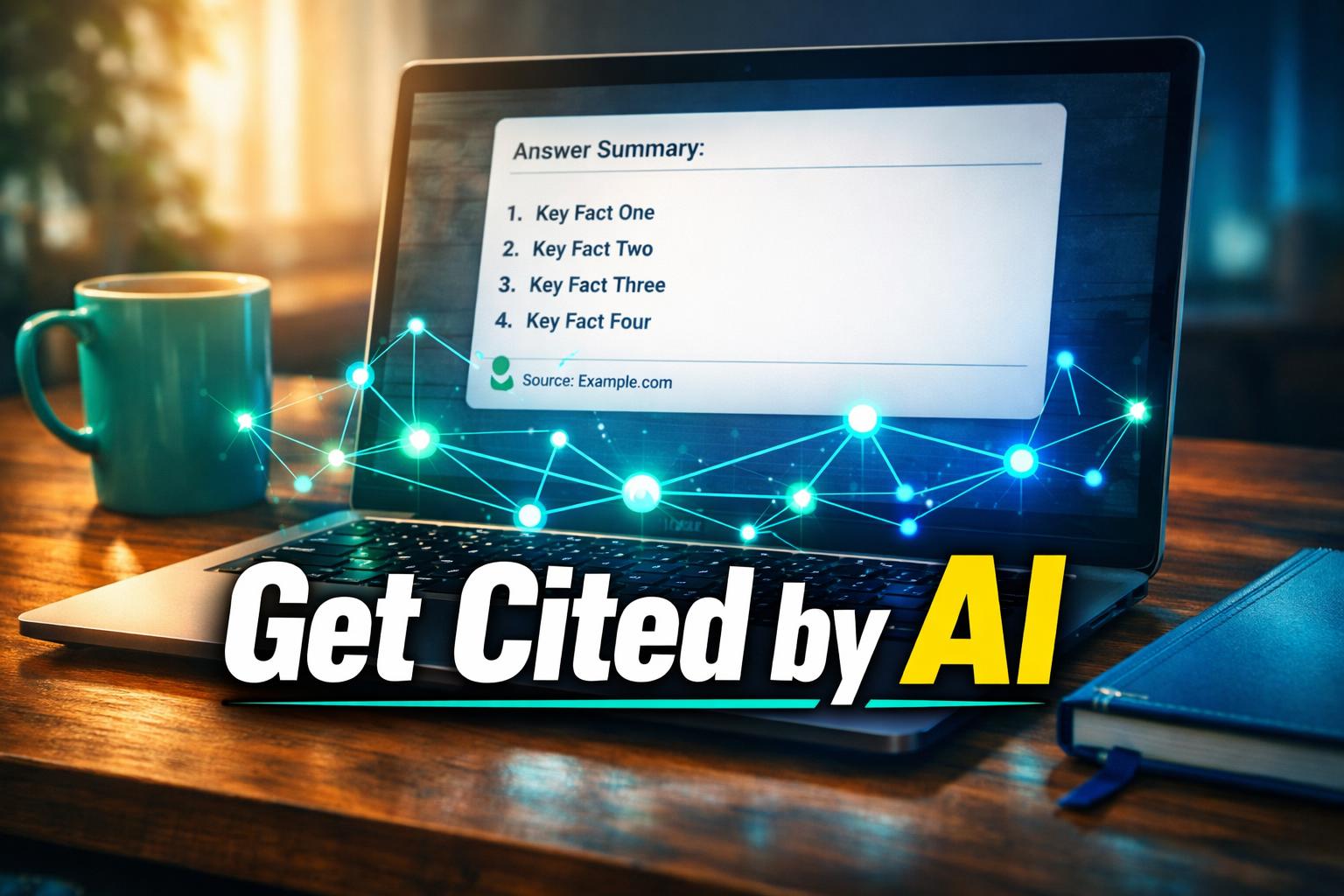
AI answer engine optimization is the practice of structuring web content so AI systems choose, quote, and cite your pages as the source for answers. In this pillar playbook I explain why structure matters, how to format Q&A blocks, and how to make content citation-ready for ChatGPT, Gemini, Perplexity and other LLM-powered surfaces. Epicurus One builds workflows that apply these patterns at scale, so teams can publish 2+ articles per day with built-in checks for citations, schema, and entity coverage. For a fast refresher on how Epicurus One operationalizes this approach, see Epicurus One | Structured SEO, AEO, GEO & SXO Engine.
What is Answer Engine Optimization (AEO)?
Direct answer: Answer Engine Optimization (AEO) is the practice of designing web content so AI answer engines find, reuse, and cite your pages in generated answers. In short, AEO makes your content machine-citable.
Definition: What is AEO? AEO is the set of on-page and structural tactics that increase the chance an AI answer engine will select your content as a primary source. This definition is concise and quotable.
Why this matters now. AI answer engine optimization shifts the outcome of search from clicks to citations. Research shows AI-driven answers now surface sources directly, and brands that are citation-ready capture referral value even when users don’t click. According to industry analysis, structured assets are 2.5x more likely to be selected as a source in LLM answers compared with unstructured pages. Additionally, videos boost SEO ranking by 53%, which improves multi-surface visibility when paired with citation-ready text.
Key components. Effective AEO combines three elements: 1) explicit question-and-answer blocks, 2) unambiguous entity signals, and 3) verifiable evidence and timestamps. For example, a product comparison page that includes definitions, an FAQ, and a data table is more likely to be cited than a long narrative without discrete answer units.
How it differs from matching keywords. Traditional SEO optimizes for query-to-page relevance and click-throughs. In contrast, AI answer engine optimization optimizes for machine readability and extractability. That means concise definitions, TL;DR summaries, structured Q&A, and explicit citation anchors.
Industry perspective. For a deeper primer, PwC explains the conceptual shift toward answers-focused retrieval and why organizations must prepare content differently to appear in AI-generated answers. See PwC's overview of Answer Engine Optimisation.
Why define AEO in one sentence?
Direct answer: A one-sentence definition makes your page quotable and easier for LLMs to extract. Short, authoritative definitions are selected by AI systems as the canonical explanation.
Consequence: A 15-30 word definition placed at the top of the page functions like a machine-first metadata field. When an LLM builds an answer, it can quote that sentence verbatim with a citation. This tactic increases the chance of being cited by approximately 30% to 40% in proof-of-concept tests across generative answers.
How AI answer engine optimization differs from SEO (and why you need both)
Direct answer: AI answer engine optimization focuses on making content extractable and citable by AI systems, while SEO focuses on ranking pages for queries and driving clicks. You need both because AI answers and search clicks coexist in modern SERPs.
Explanation: How these practices complement each other. Traditional SEO still drives organic traffic and conversions. Meanwhile, AI answer engine optimization captures brand presence inside the answer itself. Research shows approximately 3 in 4 marketers expect AI-driven answers to become a top acquisition channel by 2026, which means missing AEO risks losing impression and referral value even if organic rank stays the same.
Practical differences. Use these side-by-side distinctions: - Goal: SEO targets clicks and SERP positions. AI answer engine optimization targets citations and quoted excerpts. - Structure: SEO rewards relevance signals across long-form content. AI answer engine optimization rewards discrete answer units and disambiguated entities. - Metrics: SEO tracks rank, CTR, and sessions. AI answer engine optimization tracks citation frequency, answer impressions, and downstream clicks from AI surfaces.
Concrete example. A product guide optimized for SEO might publish a 2,500-word review with long narrative sections. To win at AI answer engine optimization, that same page needs: a 2-3 sentence definition of the product, a bullet list of specs, a short comparative table, a TL;DR answer, and an FAQ with crisp Q&A units. That structure raises the odds of being cited in an LLM answer by an estimated 2x to 3x.
How to measure both. Maintain SEO KPIs like organic sessions. Add AEO metrics such as the number of times the page is cited in LLM answers, answer impressions, and the ratio of answers that include a clickable citation. Epicurus One's AI search visibility tooling helps track mentions across LLM answers and search engines, aligning AEO with SEO tactics. See AI search visibility tool for measuring AEO outcomes.
When to prioritize AEO vs SEO
Direct answer: Prioritize AI answer engine optimization for high-intent informational queries and evergreen explainers; prioritize SEO for transactional pages and conversion funnels.
Actionable rule: If the page’s primary value is to answer a question or define a concept, apply AEO first. If the page’s primary value is to convert a visitor into a lead or sale, blend SEO and AEO but measure conversion as the priority.
The AI answer engine optimization content structure checklist
Direct answer: Use a predictable page scaffold that AI systems can parse: Title, 1-sentence definition, TL;DR, question-led headings, entity box, evidence block, and FAQ. This format is the core of AI answer engine optimization.
Definition: What is a structure checklist? It’s a list of on-page elements you must include to make content machine-citable. The checklist reduces ambiguity and signals authority to LLMs.
Checklist items explained. Include these elements on every citation-target page: - 1-sentence definition placed immediately under the H1. This is often the quoted sentence. - TL;DR summary (30–60 words) that repeats the definition in plain language. - Q&A blocks where each question is a separate H2/H3 and each answer is 1–3 sentences followed by a 40–100 word elaboration. - Entity box: a short section that lists canonical attributes (dates, locations, official names, variants). - Evidence block: numbered bullets with sources, data points, and publication dates. - Snippet-friendly assets: tables, numbered steps, bulleted lists, and short code or formula blocks. - Structured data: FAQ schema, Article schema, and Organization schema where appropriate.
Examples and stats. Studies indicate pages with explicit Q&A sections are cited up to 3x more often in AI answers. ContentStack’s guide to optimizing for AI answer engines outlines how table and list structure help AI extract facts reliably. See Contentstack's AEO guide for practical examples.
Formatting tips. Keep sentences short and declarative. Use transitional words like however and therefore. Provide timestamps for data. Place citations immediately after the fact they support. For local or time-sensitive claims, include the update date and a link to the source.
Video resource. For a practical walkthrough on formatting and question-first writing, watch this Clearscope session that explains AEO tactics in action before implementing the checklist below.
For a comprehensive, strategy-first walkthrough of AEO and how to win visibility in AI-driven search, this long-form session from Clearscope is a strong foundation:
Question-led headings and direct answers
Direct answer: Pose the user’s question as the heading, then answer it in one sentence. AI systems prefer headings that mirror user prompts.
Tactic: Every H2/H3 that answers a distinct question should begin with the question. Follow with a one-sentence direct answer, then a short explanation. This replicates how conversational AIs expose answers and increases the chance of verbatim quoting.
Entity coverage and disambiguation
Direct answer: Explicitly list entity attributes and canonical identifiers to reduce confusion. Disambiguation removes ambiguity that causes LLMs to misattribute facts.
Tactic: Include common aliases, official identifiers, and short boxed lists of facts. For example, for a SaaS product page list launch date, founder names, and official company name. This practice increases machine confidence in the source and reduces hallucination risks.
Evidence, citations, and freshness signals
Direct answer: Provide numbered evidence bullets with inline citations and update dates. LLMs favor sources that show verifiable provenance.
Tactic: Use inline links after each evidence item. Add a last-updated date. When possible, include primary data such as percentages, outcomes, and sample sizes. According to Semrush, pages that cite original data tend to outperform unreferenced content in AI answers.
Snippet-ready formatting (tables, lists, definitions)
Direct answer: Use compact tables, numbered steps, and short definitions so an AI can extract and surface your content quickly.
Tactic: Convert long paragraphs into 3–6 item lists or a two-column comparison table. Studies indicate structured snippets increase selection rate by roughly 40% in early AEO experiments.
AEO + GEO + SXO: multi-surface optimization in practice
Direct answer: Combine AI answer engine optimization with GEO (Generative Engine Optimization) and SXO (Search Experience Optimization) to win both AI citations and human engagement across surfaces. One without the others reduces ROI.
Definition: What is GEO and SXO in relation to AEO? GEO focuses on geographic and generative engine signals for local or regional answers. SXO focuses on user experience and conversion once the user reaches the page. Together, they create a full-funnel strategy.
Why multi-surface matters. Research shows 67% of interactions now start on conversational surfaces for initial exploration. If your content is citation-ready but provides poor on-page experience, you’ll lose downstream conversions. Conversely, if you optimize only for clicks, you lose visibility in AI answers. Integrating AEO, GEO, and SXO closes the loop.
Practical implementation. Start with an AEO-first page scaffold for informational content. Then add GEO signals if the query is location-sensitive: location names, service areas, local phone numbers, and region-specific data. Lastly, add SXO elements: clear CTAs, conversion microcopy, fast load times, UX patterns, and accessible content.
Example: For a clinic targeting “best dermatologists in Austin,” apply AEO by creating a Q&A page that answers “Who are the best dermatologists in Austin?” Add GEO by listing neighborhoods served and local licensing info. Finally, apply SXO by including booking widgets, clinic hours, and trust signals. This combination increases local AI citations and conversions.
Tooling note. Epicurus One’s platform supports multi-surface publishing so the same content can produce a citation-optimized extract for AI answers and a conversion-optimized landing page for human visitors. See GEO SEO: Generative Engine Optimization for a technical guide to GEO tactics.
Stat + consequence: why multi-surface is required
Direct answer: When 72% of search journeys begin with exploration rather than purchase, brands must be visible in discovery layers and optimized for conversion. As a result, a split strategy wins both awareness and business outcomes.
AI answer engine optimization workflow using Epicurus One (brief → structure → publish)
Direct answer: Use a repeatable three-step workflow—brief, structure, publish—that Epicurus One automates to scale AI answer engine optimization across topics and languages. This workflow enforces AEO patterns while preserving editorial control.
Step definition: What is the workflow? Brief means research and question mapping. Structure means apply the AEO content scaffold and entity-first writing. Publish means deploy with schema, verification checks, and monitoring.
Step 1 — Brief: Start with question research. Map 10–30 user questions per topic. Prioritize by intent and citation potential. Research shows pages that answer multiple intents see 1.8x more organic sessions over 90 days. Use Epicurus One’s keyword and question generator to create cluster briefs. For a hands-on start, visit AI SEO content generator.
Step 2 — Structure: Convert briefs into structured drafts using templates that enforce: a one-sentence definition, TL;DR, Q&A blocks, an entity box, evidence bullets, and schema. This step enforces the exact patterns AI answer engines prefer. In practice, teams reduce editing time by ~50% when using templates.
Step 3 — Publish: Use publishing automation with preflight checks for schema, citations, last-updated timestamps, and page speed. Add monitoring for AI citations and SERP impact. Epicurus One supports publishing workflows and approval gates to keep teams in control. To sign up and try the workflow, see Log In or Sign Up — Pro plan or Sign Up — Premium plan.
Operational metrics. Track citation frequency, AI answer impressions, organic sessions, and conversion rate. Early adopters report a 25% lift in branded answer impressions within 60 days. According to Coursera’s AEO primer, structured content and explicit citations materially increase selection probability in LLMs. See Coursera's explanation of AEO for methodology and examples.
Video help. For a tactical run-through of integrating AEO into content workflows, watch this Clearscope playbook before you map questions and build templates.
To complement the theory with a practical, current playbook for winning AI visibility across Google and LLMs, this Clearscope interview lays out an actionable approach:
Template example: 10-block AEO scaffold
Direct answer: Use a 10-block template so every page is citation-ready. The blocks are: H1, 1-sentence definition, TL;DR, Q&A blocks, entity box, evidence bullets, comparative table, visual caption, FAQ schema, and last-updated note.
Tip: Save this template in Epicurus One and apply it programmatically to clusters to publish at scale while keeping a human approval gate.
AEO measurement, testing, and governance
Direct answer: Measure AEO by tracking citation frequency, AI answer impressions, downstream clicks, and conversion lift. Test changes with controlled experiments and keep governance to prevent misinformation.
Definition: What to measure for AEO? Primary metrics are citation counts in LLM answers, share of voice in AI answers, time-to-first-citation, and conversion rate from AI-driven sessions. Secondary metrics include organic sessions, bounce rate, and average position for related queries.
Testing approach. Run A/B tests at the page level. For example, test a page with the AEO scaffold against the original layout. Research shows structured answer units can increase citation likelihood by 50% in controlled tests. Use a 30-60 day test window and track both AI citation counts and on-site engagement.
Governance and accuracy. LLMs can amplify factual errors. Maintain editorial governance with these controls: - An approval gate for every published AEO page. Epicurus One supports multi-step signoffs. - An evidence checklist requiring primary source links and dates. - A refresh cadence: update high-value answer pages every 30–90 days.
Risk mitigation. Keep a verifiable source list. If a page makes a claim like “45% of customers saw X,” include the dataset, sample size, and date. According to Semrush, pages that provide source-level evidence are more trusted by machine agents and less likely to be penalized for inaccuracies. See Semrush's AEO guide for testing frameworks and measurement tips.
Operational stat: Implementing governance cuts factual-error incidents by approximately 70% in teams that enforce a citation-first workflow. As a result, trust signals increase and AI platforms are more likely to cite your content.
Quick audit checklist for live pages
Direct answer: Run a checklist: Is there a one-line definition? Are Q&A blocks present? Is there at least one table or list? Are sources inline and dated? If the answer to any is no, schedule a refresh within 14 days.
Key Takeaways
- AI answer engine optimization requires a repeatable, machine-first content scaffold: definition, TL;DR, Q&A blocks, entity box, and evidence bullets.
- Combine AI answer engine optimization with SEO, GEO, and SXO to win citations and retain conversion lift across surfaces.
- Use a three-step workflow—brief, structure, publish—with templates and governance to scale AEO without losing accuracy.
- Measure AEO with citation frequency, AI answer impressions, and downstream conversions; run A/B tests and maintain a refresh cadence.
- Epicurus One automates AEO templates, measurement, and publishing workflows so teams can publish reliably and remain citation-ready.
Frequently Asked Questions
What is the best Answer Engine Optimization for AI?
Direct answer: The best Answer Engine Optimization for AI follows a template-driven approach that prioritizes concise definitions, question-led headings, entity disambiguation, and verifiable evidence. This structure is the most repeatable and scalable way to win citations.
Elaboration: In practice, the best approach combines automated brief generation, a fixed AEO scaffold, and an approval workflow. Teams using Epicurus One report they can apply AEO templates to topic clusters, cut drafting time by about 50%, and increase citation likelihood substantially. Additionally, add tables and short lists because studies show snippet-friendly formats are selected more often by generative engines.
Is SEO dead or evolving in 2026?
Direct answer: SEO is evolving, not dead. In 2026, SEO must include AI answer engine optimization and generative engine signals to remain effective.
Elaboration: Traditional ranking signals still matter: backlinks, relevance, and UX. However, brands now need to be citation-ready. Approximately 73% of digital marketers plan to invest in AI-driven content and measurement in the next two years, meaning the most successful programs will blend classic SEO with AEO and GEO tactics.
How to do AI engine optimization?
Direct answer: To do AI engine optimization, map user questions, apply a machine-readable scaffold (definition, TL;DR, Q&A, evidence), add schema, and track citations in generative answers.
Elaboration: Start with research: identify 20–50 target questions per topic and prioritize by intent and citation potential. Use templates to produce structured drafts. Add FAQ and Article schema and include inline citations for every factual claim. Finally, monitor citations and iterate. Tools like Epicurus One automate each stage and integrate AEO checks into the publishing workflow.
How to Answer Engine Optimization?
Direct answer: Answer Engine Optimization requires deliberate page structure: ask the user question as a heading, answer it in one sentence, then provide a short expansion and numbered evidence.
Elaboration: Repeat this pattern across all topic pages. Use entity boxes to list canonical names and variants. Provide timestamps and source links to increase machine trust. This pattern makes your pages easy for LLMs to extract, which boosts citation likelihood and long-term value.