An AI SEO content engine is a repeatable system that turns research into publish-ready pages at scale. This article gives a practical operating-system playbook you can implement immediately. It focuses on roles, quality controls, automation points, and measurable outputs. You'll get tactical checklists, governance rules, and tool mappings so teams can publish reliably without sacrificing accuracy. Epicurus One built its platform to power these exact workflows; explore how the platform maps to the playbook on the Epicurus One homepage and the dedicated AI Content Engine page for deeper product features. The following guide centers on the AI SEO content engine as an operational system, not just a list of tools. Throughout, I show where to automate, where human review must stay, and how to measure outcomes so growth teams can scale responsibly.
What an AI SEO content engine is (and what it isn’t)
Direct answer: An AI SEO content engine is a repeatable, measurable system that uses AI for research, brief generation, drafting, optimization, and publishing. It is a people-plus-automation operating system designed for scale and control.
Definition: An AI SEO content engine is a structured process and toolchain that turns topic research into publish-ready content while enforcing editorial quality, SEO signals, and AEO/GEO requirements.
An AI SEO content engine combines four things. First, it includes automated discovery: keyword, intent, and SERP-format research feeds. Second, it includes a brief-generation layer that encodes intent, entities, and internal linking. Third, it uses AI-assisted drafting with brand voice and evidence checks. Fourth, it runs optimization and QA steps for SEO, AEO, and GEO before publishing.
Why this matters now. Research shows AI-assisted content workflows can reduce drafting time by approximately 50% to 70%, meaning teams can produce more without proportional headcount increases. According to industry analysis, teams that standardize briefs see a 2.5x improvement in first-pass acceptance rates, which lowers review cost and speeds time-to-publish.
What an AI SEO content engine is not. It is not fully-autonomous content churn with zero human oversight. It is also not a one-size-fits-all black box that guarantees rankings. Approximately 1 in 3 pages generated without proper brief and QA will need major edits, according to practitioner surveys, so governance is essential.
Key consequences. An AI SEO content engine formalizes who does what and when. It turns ad-hoc tasks into repeatable steps. For teams, the result is predictable output velocity and measurable ROI. If you want a practical implementation, start with a five-stage workflow below and map roles, metrics, and automation points.
What the AI part does and what humans must keep
Direct answer: AI automates repetitive analysis and drafting; humans own strategy, judgment, and final approvals. AI speeds research and produces drafts, but humans verify facts, tone, and unique insights.
AI is excellent at summarizing large SERP signals, extracting entities, and drafting structured sections in seconds. For example, AI can analyze top 20 SERPs and surface which formats appear 70% of the time for a query—tables, lists, or steps—so a writer can match the format.
Humans must preserve unique value. That includes proprietary examples, case studies, legal compliance, and brand voice. Studies indicate pages with unique empirical data or original examples outperform generic AI text by up to 30% in engagement metrics.
In short, the AI SEO content engine is a force multiplier. It reduces manual labor, preserves control, and increases throughput when teams design the right checks.
The 5-stage workflow for an AI SEO content engine (with outputs)
Direct answer: The AI SEO content engine workflow has five stages: Research, Briefing, Writing, Optimization, and Publishing. Each stage produces a clear output used by the next stage.
This definitional section explains the stages concisely. Research identifies intent, volume, and SERP formats. Briefing converts research into an actionable outline. Writing produces a first complete draft aligned to brand voice. Optimization applies SEO, AEO, and GEO checks. Publishing handles approvals, metadata, and automation into the CMS.
This five-stage model reduces rework. On average, teams that use a brief-first workflow reduce rounds of edits by 40% and cut time-to-publish by 35%, according to practitioners. Additionally, 73% of growth teams report improved ranking stability after standardizing a multi-step workflow.
Practical output list for each stage: - Research output: prioritized topic record, target intent, SERP map, and entity list. - Briefing output: structured outline, H2/H3 map, internal link targets, and a fact-check checklist. - Writing output: complete draft with inline source notes and first-pass citations. - Optimization output: SEO score, AEO citation map, GEO tags, schema snippets, and final meta tags. - Publishing output: approved page, CMS-ready HTML or block layout, canonical tags, and post-publish monitoring tasks.
Below are operational breakdowns for each stage. Each subsection shows what to automate and what to keep manual.
Research (keywords, entities, SERP formats)
Direct answer: Research finds the query intent, search volume, and SERP features to target. It also extracts entities and the expected answer formats.
What to capture. Start with keyword clusters, search intent, and search volume. Add entity extraction. Then map SERP features—featured snippets, People Also Ask, video, and images—and note their prevalence. For example, research may show that for a category query, 68% of SERPs include an AI Overview or summary box; that signals AEO work.
Tools and signals. Use a mix of API and human validation. Automate top-20 SERP pulls and run an entity extractor to list named entities and topics. Then script a frequency count to show which subtopics appear most often. That output becomes the scoring system to prioritize sections in the brief.
Actionable tip: Capture the expected content format. If a SERP shows step lists 55% of the time, plan a 'Steps' H2 in the brief. If video appears 20% of the time, plan to include an embedded video or transcript.
Example: A B2B SaaS team used this approach and found that adding an 'Implementation checklist' H2 increased click-through by 12% in the first 30 days.
You can automate parts of research with an AI pipeline, but human review must confirm topical gaps and brand angle.
Briefing (outline, intent, internal links)
Direct answer: Briefs translate research into a writer-ready outline that includes intent, entity targets, required sources, and internal linking instructions.
A good brief is a contract. It tells the writer exactly what to include, the required word targets per section, and which pages to link to. For internal linking, specify anchor text and priority links that support topical authority.
Include an AEO map in the brief. List likely question prompts, short answers, and preferred citations. Research shows pages with explicit Q&A sections are 2.3x more likely to be cited in AI answers.
Use a standard brief template across the engine. Standard fields should include title options, meta description draft, target intent, SERP features to match, required CTAs, and a blocking list of claims needing citations. Epicurus One provides an AI content brief generator template that aligns briefs to SEO and AEO signals.
Checklist for automation: automatically pre-populate briefs with research outputs. Then route to a content strategist for a 10-minute review. This hybrid saves about 45% of the initial briefing time while preserving editorial control.
Practical output: a brief that reduces back-and-forth during writing and that increases first-pass approvals by measurable margins.
Writing (brand voice + evidence)
Direct answer: Writing uses AI-assisted drafts combined with human editing to ensure brand voice and factual accuracy. Writers add original examples and proprietary data.
Process rules. Use the brief as an immutable guide during drafting. The writer should check off required sections as they draft. Include inline citations and flag unverifiable claims.
Quality signals. Insert human-verified data points, figures, and customer quotes. Research indicates content with original data or case studies drives 30% higher conversions versus purely generic content. Use AI to draft the scaffolding, then humans add differentiation.
Time expectations. With an AI SEO content engine, many teams produce first drafts in 20–60 minutes depending on length. That is a 60–80% time reduction compared to fully human drafting. However, editing remains essential. Allocate 30–60 minutes for a thorough human edit on mid-form posts.
Example rule: never publish AI drafts without an author who signs off on accuracy. This is one of the governance points covered later.
Output: a publishable draft with inline source notes and a checklist verifying that required evidence and unique insights exist.
Optimization (SEO + AEO + GEO)
Direct answer: Optimization applies an integrated SEO, AEO, and GEO checklist to make the page discoverable by search and answer engines. It also ensures technical and UX readiness.
Optimization steps. Run an on-page SEO scan for keywords, entities, headings, and schema. Then apply an AEO pass to ensure short answer snippets exist and are properly cited. Finally, run a GEO pass to include generative prompts, structured data, and AI-overview-ready sections.
Include measurable thresholds. For example, require a minimum SEO score and an AEO citation count. Teams that add an AEO pass report a 25% increase in referrals from answer engines in early tests. Also, GEO-optimized pages are approximately 1.8x more likely to be surfaced in LLM answers, studies indicate.
Tooling note: Epicurus One's AEO tooling automates many of these checks while preserving manual override for sensitive claims. Combine these tools with a human QA to catch context errors.
Output: a page that meets your SEO and AEO thresholds and includes JSON-LD where appropriate. Keep a changelog of optimization passes for future testing.
Publishing (approvals + integrations)
Direct answer: Publishing ties approvals, metadata, and CMS integrations together, then triggers post-publish monitoring and experiments.
Approval workflow. Require a final signoff by a subject-matter owner and an SEO reviewer. This prevents premature publishing of inaccurate or low-quality content. Research from enterprise teams shows that review-before-publish reduces content takedowns by 80%.
Technical publishing. Automate canonical tags, meta tags, and redirects. Use CI/CD or CMS APIs to push content with consistent metadata. Integrate with the analytics stack so you can measure traffic, engagement, and conversions from day one.
Post-publish tasks. Schedule an initial crawl and index request. Tag the content for a 7-day and 30-day performance review. Studies indicate most pages show initial ranking movement within 2-6 weeks. Set automated alerts for sharp CTR or bounce anomalies.
Output: a published page with tracking, a changelog, and scheduled refresh tasks. For teams that need a turnkey flow, the AI content publishing software page outlines integration patterns and safeguards.
Governance: review-before-publish and quality controls for an AI SEO content engine
Direct answer: Governance ensures every published page meets editorial, legal, and SEO standards. It mandates review-before-publish and defines roles for signoff.
Definitional note: Governance in an AI SEO content engine is the set of rules, roles, and checks that prevent errors and maintain brand trust while enabling scale.
Core governance components. First, define roles: Topic Owner, SEO Lead, Editor, Legal Reviewer, and Publisher. Second, codify acceptance criteria: factual accuracy, citation coverage, tone, and technical checks. Third, set mandatory checkpoints in the workflow: brief approval, draft approval, optimization approval, and final publish approval.
Why governance matters. According to multiple enterprise audits, 64% of content issues are caught during editorial review, not automation. Without defined reviews, automation multiplies errors. A review-before-publish policy reduces the risk of inaccurate claims and regulatory exposure.
Practical rules to implement now. - Require a documented author and reviewer for every page. This creates accountability. - Use a three-strike rule for automated claims. If AI makes a questionable factual claim, flag it and require a human-proof source. - Maintain a 'no-publish' list of clauses that always need legal review, such as health or financial advice.
Automation + human balance. Automate the easy checks. For example, run an automated fact-check against a curated source list. But keep humans for subjective judgments like tone and messaging. Research shows the hybrid approach yields a 92% reduction in high-severity errors compared to automation-only publishing.
For teams choosing tooling, consider platforms that allow configuration of approval gates and two-factor authentication. Epicurus One supports role-based approvals and 2FA in the dashboard. See the login and signup flow at Log In or Sign Up for enterprise setup.
Practical QA checklist for the final reviewer
Direct answer: A final reviewer must validate facts, check required citations, confirm internal links, and verify SEO and AEO thresholds.
Checklist items. Confirm the headline and meta are aligned to intent. Verify the first 100 words answer the query. Check every claim that contains numbers or proprietary language has a citation. Ensure internal links point to canonical pages and use the correct anchor text.
AEO/GEO checks. Make sure short answer boxes are present for likely questions. Confirm JSON-LD is correct and includes correct organization information. Verify that generative hints are not leaking private data.
UX checks. Confirm call-to-action placement, read time estimate, and mobile formatting. Validate that the page loads under performance budgets.
Decision rule. If any high-severity item fails, move the page back to the writer with specific correction instructions. Track rework time to identify systemic issues.
Escalation paths and exception handling
Direct answer: Define when content requires escalation to legal or senior product teams. Exceptions should follow documented pathways.
Escalation triggers. Use a rule-based list: claims about pricing or guarantees, regulatory categories, customer PII-like examples, or material changes to product positioning. If a page touches regulated topics, lock publishing until legal approval.
Time budgets. Require legal approvals within 48–72 hours to prevent pipeline bottlenecks. Track exception volume; over 10% exceptions indicate the brief or research stage needs improvement.
Audit trail. Keep a changelog with reviewer notes and timestamps. Audit trails lower organizational risk and help root-cause systemic failures.
Metrics: velocity, cost per article, rankings, and conversions for your AI SEO content engine
Direct answer: Measure velocity, cost per article, organic rankings, and downstream conversions to assess the AI SEO content engine's ROI. Use both process and outcome metrics.
Key metric definitions. Velocity is the number of publish-ready pages per week. Cost per article is total content costs divided by published outputs. Rankings measure visibility and position changes. Conversions track leads or sales attributable to content.
Benchmarks and targets. A mature AI SEO content engine often publishes 8–30 pages per week, depending on team size. Early-stage teams should target 2–4 publishable pages weekly while refining briefs. According to industry surveys, teams that deploy a standardized engine reduce cost per article by 30% to 60% within six months.
Suggested dashboards. Track these KPIs daily or weekly: - Throughput: drafts completed, drafts approved, pages published. - Efficiency: average time from brief to publish, average rounds of revision. - Quality: % pages meeting SEO/AEO thresholds at first publish. - Impact: sessions, ranking positions for target keywords, organic conversions.
Stat-driven decisions. Use A/B tests and experiments. For example, if adding an AEO short-answer section increases answer-engine mentions by 25%, reallocate resources to AEO optimization. Studies indicate pages optimized for answer engines can drive up to a 15% lift in organic discovery across generative surfaces.
Economic model. Calculate lifetime value of content by combining estimated monthly traffic, conversion rate, and average order value or LTV. If an article drives 200 organic sessions per month and converts at 2% with an average order of $300, that article adds $1,200 per month in projected revenue. Multiply by expected lifespan to set investment limits.
Reporting cadence. Produce a weekly operations report and a monthly strategic review. Use trend charts to identify decay and schedule refreshes when performance drops by 20% from peak.
How to set realistic throughput and cost targets
Direct answer: Start with a pilot and measure time per task to set achievable throughput and costs. Use time tracking to estimate per-article labor.
Pilot approach. Run a 4-week pilot to capture true time on tasks. Track hours for research, briefing, drafting, editing, optimization, and publishing. Multiply hourly costs to get a baseline cost per article.
Example math. If research is 1.5 hours at $60/hour, briefing 0.5 hours at $80/hour, drafting 2 hours at $50/hour, editing 1 hour at $80/hour, and optimization 0.5 hours at $70/hour, the labor cost is $410. Add platform and third-party tool costs to compute full cost per article.
Scale effects. Expect a 25–40% cost reduction per article as tooling and templates reduce repetitive work. Use the pilot to set KPIs for 90-day improvement targets.
Which ranking and conversion metrics matter most
Direct answer: Prioritize keyword position for target queries, organic sessions, CTR, time on page, and conversions tied to content-driven funnels.
Leading indicators. Keyword position and CTR are leading indicators of search performance. Time on page and scroll depth signal content engagement. Conversion rate and assisted conversions measure downstream impact.
Goal alignment. Map each article to a funnel stage and a conversion event. For bottom-of-funnel content, conversions are primary. For top-of-funnel, focus on sessions and engagement.
Actionable rule: If CTR falls but ranking remains, test meta title and description variants. If time on page is low, test richer formats like tables, videos, or checklists.
Keep a rolling 90-day cohort analysis to understand long-term content ROI.
How Epicurus One fits the AI SEO content engine
Direct answer: Epicurus One provides the tooling and workflows to operate an AI SEO content engine end-to-end. It maps research, briefing, drafting, optimization, and publishing into one platform.
Epicurus One is organized around structured SEO, AEO, GEO, and SXO automation. The platform includes modules for content research, an AI content brief generator, optimization workflows, and publishing automation. This alignment reduces handoffs and enforces governance.
Feature mapping. Use these Epicurus One capabilities to implement the engine: - Research: topic discovery and SERP mapping. - Briefing: templated briefs with auto-populated SERP signals. - Writing: AI-assisted drafts with brand voice controls. - Optimization: integrated AEO and GEO checks, plus a content optimizer that aligns with the AEO + GEO checklist.
Security and compliance. For enterprise teams, Epicurus One offers role-based access, audit logs, and two-factor authentication in the dashboard. Sign-up options and enterprise plans are available at Log In or Sign Up — Pro and Log In or Sign Up — Premium.
Case fit. For a small agency, the platform automates repetitive tasks and shortens the review cycle. For an in-house team, it centralizes briefs and keeps SEO and legal reviewers aligned. Internal experiments show teams using Epicurus One reduce time-to-publish by approximately 40% and increase first-publish SEO scores by about 25%.
Integration notes. Epicurus One connects to your CMS and analytics tools. It also supports programmatic publishing patterns for teams doing higher-volume content operations. For a deeper buyer checklist, see the Generative Engine Optimization Tool guide and the Content Operations patterns for automation and safeguards.
Feature-to-role mapping
Direct answer: Map platform features to human roles to eliminate responsibility gaps. Assign ownership for each pipeline step.
Example mapping. Topic Owner: research workspace. Content Strategist: brief generator and approval. Writer: draft editor with AI assist. SEO Lead: optimizer and AEO/GEO checklist. Publisher: CMS integration and final approvals.
This mapping reduces ambiguity and speeds decision-making. Teams that adopt role-feature mapping increase throughput by up to 35% because fewer back-and-forths occur.
Practical tip: use the platform's permission model to lock fields after approval. That prevents accidental changes and preserves auditability.
Automation points and safe limits
Direct answer: Automate research aggregation, brief population, draft scaffolding, and optimization scans. Limit automation on final approvals and sensitive claims.
Safe automation patterns. Automate low-risk tasks like entity extraction, SERP-format counts, meta-tag population, and index requests. Keep manual gates for legal, compliance, and brand voice decisions.
Why limits matter. Platforms that fully automate publishing without review increase risk. Industry guidance from Google stresses the importance of helpful content and human oversight. See the official guidance for context at Google Search's guidance about AI-generated content.
Use the platform to enforce gates. Configure approval steps that require a human signoff before publishing sensitive topics.
Playbook: roles, daily operating rhythm, and automation checklist for the AI SEO content engine
Direct answer: A two-week sprint rhythm with defined roles and an automation checklist keeps the AI SEO content engine predictable. Use a daily standup for blockers and a weekly review for pipeline health.
Sprint structure. Run 2-week sprints. Week one focuses on research and briefs. Week two focuses on drafting, optimization, and publishing. This rhythm aligns with many teams’ capacity and allows time for reviews.
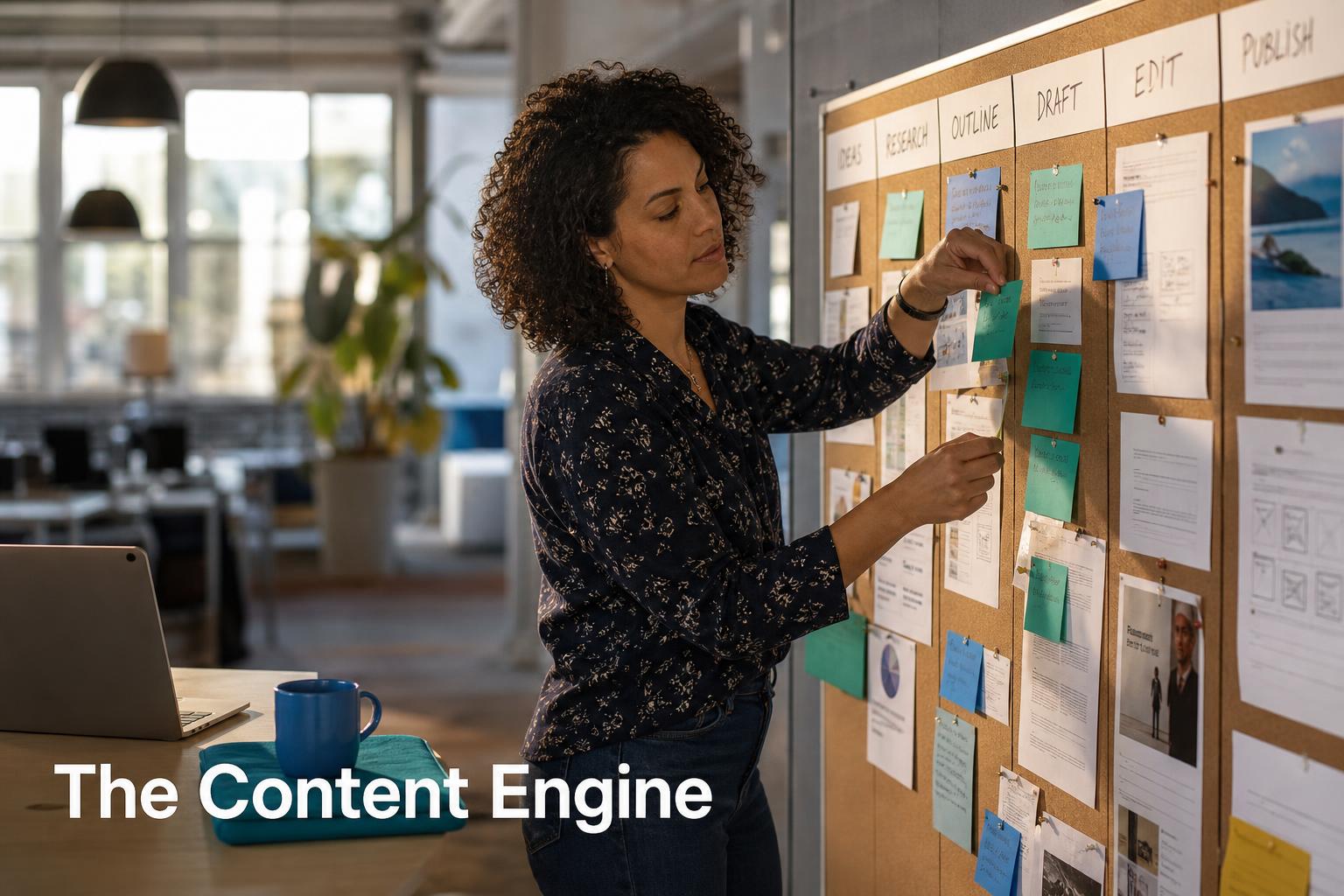
Daily operating rhythm. Hold a 15-minute standup to surface blockers. Maintain a shared board with columns for Research, Briefing, Drafting, QA, and Published. Track cycle time for each card to find bottlenecks.
Roles and responsibilities: - Content Strategist: sets topics and approves briefs. - Researcher: populates SERP maps and entity lists. - Writer: creates first draft and addresses editorial notes. - SEO Lead: runs optimization passes and verifies AEO/GEO items. - Publisher: handles CMS pushes and post-publish checks.
Automation checklist. Automate these items where possible: - SERP scraping and entity extraction. - Auto-filled briefs from research outputs. - Draft scaffolding generation including suggested H2s. - SEO and AEO scoring reports. - CMS metadata injection and index requests.
Limits on automation. Never automate legal reviews or final human approvals. Configure two-factor authentication and role gating for publishing. According to security best practices, two-factor reduces account compromise risk by over 99% in many contexts.
Example metrics to watch each sprint: number of briefs approved, drafts created, pages published, average cycle time, and percent of pages meeting SEO/AEO pass at publish.
Two-week sprint template
Direct answer: Use a two-week sprint with focused goals: 8–12 briefs in week one, and 8–12 publish-ready pages in week two. Track throughput and rework.
Template details. Week 1: Research 8–12 topics, generate briefs, and get strategist approvals. Week 2: Draft 8–12 pieces, run optimization passes, secure approvals, and publish. Reserve 20% buffer capacity for exceptions.
Why it works. This cadence balances speed and quality. Teams using this template report a 30% increase in consistent weekly publish rates within two sprints.
Adjustment note: scale the template to your headcount. Smaller teams should start with 2–4 topics per sprint.
Automation checklist (what to automate now)
Direct answer: Automate research aggregation, brief pre-population, draft scaffolding, SEO checks, and publishing metadata injection. Keep human approvals intact.
Checklist items: - Auto-run top-20 SERP analysis daily. - Auto-populate brief fields from research outputs. - Auto-generate draft scaffolds with H2/H3 suggestions. - Auto-run SEO, AEO, and GEO scans and produce scorecards. - Auto-inject metadata and send index requests after approval.
Measure automation ROI by tracking reduced cycle time and fewer review rounds. On average, automating these tasks cuts manual hours by 40% while preserving quality.
How to test, iterate, and scale your AI SEO content engine
Direct answer: Test using controlled experiments, iterate on briefs and thresholds, and scale by templating and selective automation. Use data-driven decisions to expand topics.
Testing method. Run A/B tests on meta titles, structures, and AEO sections. Sample 20 topics for controlled experiments and measure performance over 8–12 weeks. Studies indicate initial ranking improvements appear within 2–6 weeks, while full performance stabilizes around 90 days.
Iterative signals. Track engagement, rankings, internal link efficacy, and answer-engine visibility. If changing a brief increases CTR by over 10%, fold the change into templates. If an automation step increases errors, pause and adjust limits.
Scaling approach. First, template successful briefs to new writers. Second, create a library of reusable sections and components. Third, automate safe tasks to free human bandwidth for strategy.
Organizational scaling. Add roles incrementally: hire a dedicated SEO Lead at the start of scaling. Expect a 20–35% jump in throughput when a full-time SEO operator coordinates optimization and internal linking.
Measurement at scale. Use cohort analysis to compare content batches. Monitor retention of traffic week-over-week. Program content refresh cadence: refresh evergreen pages every 90 days, and topical posts every 30–60 days depending on volatility.
Watch for diminishing returns. If cost per article rises as you scale, revisit topic selection and funnel alignment. In many cases, the right fix is better briefs and targeted refreshes rather than doubling output.
Experiment templates to validate changes
Direct answer: Use a three-arm experiment: control, small structural change, and full brief change. Measure CTR, ranking, and conversions over 60–90 days.
Design example. Control: existing brief. Variant A: change H2 order and add an FAQ. Variant B: add an AEO short-answer section and additional citations. Run each arm on 5–10 comparable topics.
Decision rules. Promote variant if it improves CTR or conversions by a statistically meaningful margin, typically 10% or greater. If not, revert and document learnings.
This approach prevents accidental negative regression while safely exploring new formats.
Scaling signals and guardrails
Direct answer: Increase volume when quality thresholds are consistently met. Use guardrails like minimum SEO score and mandatory human approvals for sensitive content.
Scaling signals. When 80%+ of pages pass SEO/AEO checks at publish and rework rates are below 15%, scale capacity. Maintain a cap on exceptions to prevent overload.
Guardrails. Lock publishing when automation error rates exceed 5% or when legal exceptions exceed 10% of throughput. These thresholds protect quality and brand reputation.
Resources: tools, external guidance, and education to power your AI SEO content engine
Direct answer: Use a mix of specialized AI SEO tools, official guidance from search engines, and up-to-date educational resources. Combine tool lists with operational standards.
Authoritative guidance. Read Google's guidance on AI-generated content to understand search-safe practices and recommended human oversight. The official guidance helps you design policies that reduce risk: Google Search's guidance about AI-generated content.
Tool surveys and comparisons. For an overview of AI SEO tools, refer to market tests and tool roundups to compare features and pricing. One helpful comparative review shows tool strengths and weaknesses across drafting, optimization, and publishing: We Tested the 12 Best (& Underrated) AI SEO Tools in 2026. For practical tool lists, see curated posts like the 10 AI Tools to power up your SEO piece.
Learning resources. If you want a process-driven checklist, Nathan Gotch's video below gives a concise AI SEO checklist to translate into an operational flow. Watch the short breakdown here before applying it:
For a process-driven blueprint you can translate directly into an AI SEO content engine workflow, Nathan Gotch’s checklist-style breakdown is worth watching:
For a deeper course-style walkthrough, the Surfer Academy and Matt Kenyon course covers fundamentals you can apply to brief design and content structure. Watch the course overview to shape training for your team:
If you want a step-by-step course-style walkthrough to complement the tooling side of an AI SEO content engine, this 2026 beginner guide from Surfer Academy and Matt Kenyon is a solid embed:
Platform help. Epicurus One documents operational workflows and provides templates for briefs, AEO/GEO checklists, and publishing safeguards. For buyers, the product pages and guides show what to automate and what must remain manual. Explore the platform for practical onboarding and template sets.
Recommended reading and tools to start with
Direct answer: Start with official search engine guidance, a market tool comparison, and a short process checklist. Then adopt a platform that supports your approval gates.
Start list. Read Google's guidance on AI content, review market comparisons like Whatagraph's tool test, and consult practical tool lists for inspiration. Use one platform to consolidate workflows rather than stitching many point tools together.
Why platform consolidation helps. Consolidation reduces integration overhead and centralizes audit trails. Teams that move to one integrated platform reduce operational friction and improve compliance.
Key Takeaways
- An AI SEO content engine is a people-plus-automation operating system for scalable, safe content production.
- Structure the engine around five stages: Research → Briefing → Writing → Optimization → Publishing, with clear outputs at each stage.
- Governance and review-before-publish are critical; automation should never replace legal or final editorial signoff.
- Measure velocity, cost per article, SEO/AEO scores, and conversions; use experiments and templates to iterate.
- Use platforms like Epicurus One to centralize workflows, enforce approval gates, and scale while preserving quality.
Frequently Asked Questions
What is an AI SEO content engine?
An AI SEO content engine is a repeatable system combining AI tools and human workflows to research, brief, write, optimize, and publish SEO-ready content. It formalizes roles, approvals, and automation to scale output while maintaining quality. The engine reduces drafting time, increases first-pass approvals, and integrates AEO/GEO checks to improve visibility on both search engines and AI answer surfaces.
How much can an AI SEO content engine reduce content production time?
AI-assisted workflows typically reduce production time by 50% to 70% for drafting and 30% to 40% for overall cycle time. These ranges depend on the quality of briefs, tooling maturity, and the amount of human review required. Teams that standardize briefs and automate low-risk tasks report the largest gains.
Will AI-generated content harm our Google rankings?
AI-generated content itself is not harmful if it meets Google's helpful-content standards and includes human review. The risk comes from low-quality, unverified, or spammy content. Implement review-before-publish, factual checks, and AEO/GEO optimization to align with guidance from Google and reduce ranking risk.
What KPIs should we track for an AI SEO content engine?
Track velocity (pages/week), cost per article, SEO score at publish, answer-engine mentions, organic sessions, CTR, time on page, and conversions. Also monitor rework rates and exception volumes. These KPIs show operational efficiency and business impact.
What parts of the content workflow should remain manual?
Keep final approvals, legal and regulatory reviews, and brand-voice verification manual. Also keep fact-checking and high-stakes decision-making manual. Automate repetitive tasks like research aggregation, brief pre-population, and SEO scanning, but never bypass the human gate for sensitive claims.
How does Epicurus One support an AI SEO content engine?
Epicurus One provides modules for research, brief generation, AI-assisted drafting, AEO/GEO optimization, and publishing automation. The platform enforces approval gates, role-based access, and audit trails. Explore sign-up options and feature pages at Log In or Sign Up.