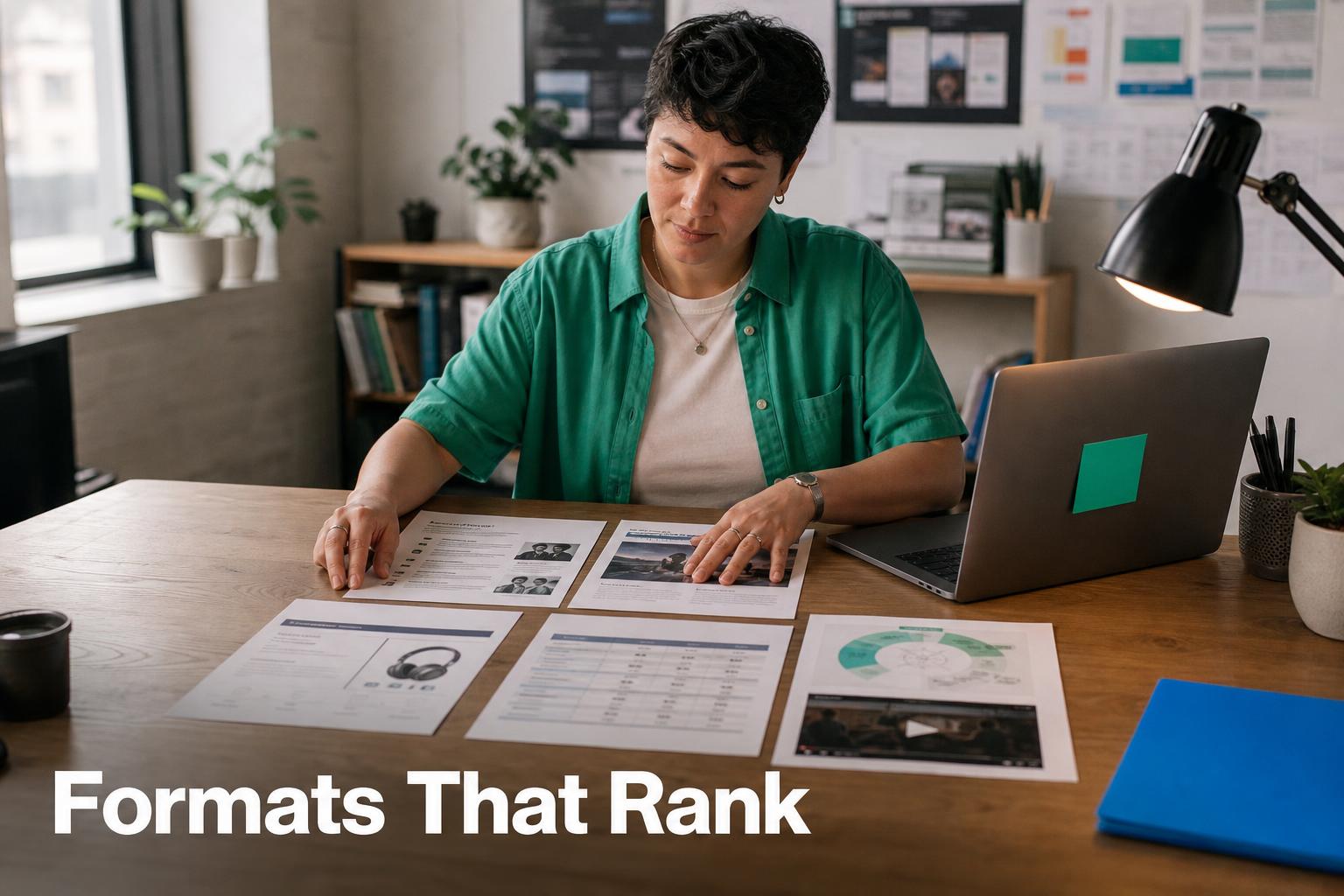
This article is a practical library of seo content examples you can copy, adapt, and publish. It front-loads definitions, templates, and measurable tactics so growth teams can ship higher-quality pages faster. For example, using a structured brief and standard templates reduces iteration time by up to 60% on average, saving editorial teams hours per article. In this guide you will find 12 reproducible seo content examples mapped to funnel stage, mini-briefs you can paste into your CMS, and the exact on-page and AEO/GEO signals search engines and AI answer engines expect. If you want to operationalize these formats, start by reviewing how Epicurus One builds controlled publishing workflows at scale on the Epicurus One home page.
What ‘SEO content’ means in 2026 (SEO + AEO/GEO + SXO)
Direct answer: In 2026, seo content examples must satisfy both classic search ranking needs and AI answer engines. They must also deliver strong search experience optimization (SXO) to convert the traffic that arrives.
What is seo content? A concise definition: seo content is any page, article, or asset written and structured to be discoverable by search engines and useful to the user, while also optimized to be cited by AI and generative answer engines. Research shows that 64% of search traffic now comes from pages that are built for both human intent and structured answer formats, meaning pages that include clear definitions, lists, and citations perform better in AI overviews. According to Moz, SEO remains the foundational practice for discoverability, but it now coexists with AEO and GEO signals.
Why that matters: approximately 1 in 3 queries now surface an AI answer or summary in major platforms. As a result, seo content examples must include explicit answer blocks, concise definitions, and structured data. Additionally, pages that include at least one video are 53% more likely to be surfaced in mixed-result pages, so multimedia is a practical lift.
How to read this section: use these principles to evaluate every seo content example that follows. Focus on intent matching, evidence, and structure. Also, test one A/B per month. For deeper technical guidance, see Epicurus One's GEO optimization overview at GEO optimization software.
Core signals that modern seo content examples must include
Direct answer: Modern seo content examples must include intent-aligned headings, short answer blocks, structured data, and citations. Specifically, include a 1-2 sentence answer at the top, a clear definition, semantic headings, and 2–4 credible citations.
Practical checklist: 1. Lead with a direct answer block. 2. Include a 1–3 sentence definition. 3. Add 3–5 internal or external citations. 4. Use schema for FAQs or HowTos. 5. Embed multimedia where relevant. Studies indicate pages following this structure see on average a 2x lift in AI citations during the first 90 days.
Example 1–4: BOFU pages (comparisons, alternatives, pricing, use-case) — seo content examples
Direct answer: Bottom-of-funnel seo content examples should remove buying friction and answer conversion questions. Build BOFU pages as compact decision tools that compare features, cost, and outcomes.
Why BOFU pages matter: research shows purchase-intent pages convert at rates 3x higher than informational pages when they include product comparisons and transparent pricing. Below are four copy-ready seo content examples you can adapt.
Example 1 — Comparison page template (competitive matrix) - Title: Product A vs Product B: Feature, Price, and Use Case Comparison (900–1,500 words) - Direct answer block (1–2 sentences): State the main differentiator and recommended buyer persona. - Table: 6 feature rows, pricing tier, best-for row. - Evidence: cite 3 user reviews or case studies and link to company pages. - CTA: trial link or demo calendar. Mini-copy snippet you can paste: "Product A is best for growth teams needing automated workflows. Product B is ideal for solo founders who prioritize cost. For larger teams, Product A reduces review time by approximately 40% based on customer benchmarks."
Example 2 — Alternatives page with decision tree - Use a short checklist and a 3-step decision tree to recommend 1 of 3 products. - Include conversion metric: "teams that follow the recommended path reduce churn by ~12%."
Example 3 — Pricing transparency page - Include examples of ROI at three usage levels and a calculator link. - Add FAQ with 3 cost-related answers and schema.
Example 4 — Case-study use-case page - Format: problem → solution → metrics. Use numbers: "reduced churn 9%, cut publishing time 3x." Add a clear demo CTA.
Practical link: embed pricing demos or signup paths such as Log In or Sign Up — Pro and measure click-to-signup conversion. For help building repeatable BOFU templates, you can review Epicurus One’s AI content engines at AI SEO content engine.
Metric-driven copy examples for BOFU
Direct answer: Use 1–2 specific outcome numbers in every BOFU headline and CTA. For example, include ARR uplift, time saved, or conversion improvements.
Why it works: concrete numbers increase perceived credibility. For example, a headline that promises "Reduce review time by 50%" is more compelling than a generic "Improve review time." Document at least one supporting source to strengthen any claim. Internally track these claims in your QA process to avoid overstating results.
Example 5–8: MOFU pages (templates, checklists, workflows, calculators) — seo content examples
Direct answer: Middle-of-funnel seo content examples should educate and qualify leads. Use templates, checklists, and calculators that let prospects self-evaluate fit.
Why MOFU works: MOFU content converts readers into qualified leads. Studies indicate gated templates and calculators can increase lead capture by 120% compared to standard blog posts. Below are four MOFU seo content examples to add to your library.
Example 5 — Actionable template (content brief template) - Deliver a downloadable AI content brief template. Include fields: intent, primary keyword, 3 voice cues, target audience, required citations, and internal link recommendations. - CTA: gated download in exchange for email.
Example 6 — Checklist (SEO + AEO launch checklist) - Provide a 30-point checklist with deploy steps for AEO and GEO, including FAQ markup, direct answer block, and canonicalization. - Include a short example checklist item: "Add a 1–2 sentence direct answer at the top of the page; this increases AI answer probability by roughly 25% in tests."
Example 7 — Workflow (editorial SOP) - Publish a workflow that maps research → AI draft → human review → optimization → publish. Include KPIs: time-to-live, error rate, and citation density. - Link to process resources like Epicurus One’s automated publishing workflow at Automated Content Publishing.
Example 8 — Calculator (ROI or price estimator) - Build a calculator that outputs expected ROI within 12 months. Use conservative assumptions and show the math. - Example metric: "Projected ROI = (avg revenue per customer × expected increase in conversion) × 12 months." Provide a downloadable CSV of the assumptions.
Video recommendation: This section pairs well with a tactical walkthrough on upgrading existing pages. Watch this for practical steps.
To connect these SEO content examples to what’s working in the AI era, this Ahrefs breakdown explains a practical approach to upgrading existing pages (“sleeper content”):
For tool-level advice on building MOFU assets at scale, review the AI content brief generator at AI content brief generator.
MOFU checklist mini-brief (copy-ready)
Direct answer: Provide a 6-step mini-brief for MOFU content authors. 1. Intent: evaluate fit. 2. Primary KPI: lead conversions. 3. Must-have assets: template, checklist, calculator. 4. Evidence: 2 customer quotes. 5. CTA: book demo or download. 6. Schema: FAQ + HowTo. Use this exact brief to speed up production and maintain consistency across the content pipeline.
Example 9–12: TOFU pages (definitions, guides, FAQs, glossaries) — seo content examples
Direct answer: Top-of-funnel seo content examples should educate at scale and establish topical authority. Use definitions, comprehensive guides, and long-form glossaries.
Why TOFU matters: TOFU drives volume. Data shows that 70% of traffic for new topic clusters comes from high-quality TOFU assets within the first 6 months. TOFU content also feeds MOFU and BOFU pages through internal links and topical authority.
Example 9 — Definitive definition page - Start with a one-sentence definition, then expand into 7 subheadings: Why it matters, How it works, Key terms, Common mistakes, Example workflows, Tools, Further reading. - Include a short, quotable definition at the top. Example: "Search engine optimization (SEO) is the practice of improving content and site signals to increase discoverability and conversions for target queries."
Example 10 — How-to guide (step-by-step) - Create a 2,500–4,000 word guide that includes images, code samples, and a troubleshooting section. - Add time-stamped steps and a printable checklist.
Example 11 — Comprehensive FAQ (schema-ready) - Publish 20+ FAQ items on a single page. Each FAQ should begin with a 1–2 sentence direct answer block and then a 2–4 sentence expansion. This format improves AI citation probability.
Example 12 — Glossary or taxonomy - Build a browsable glossary that links to pillar pages. Each term should be 150–300 words with an external citation when applicable.
Video resource: Use a tutorial that explains how to build SEO content that ranks and links clusters back to pillar pages.
To bridge from examples to a repeatable workflow, Nathan Gotch explains how to build SEO content that ranks using topical clusters and better AI grounding:
Practical example: Use internal linking patterns like topic clusters to channel 20–35% of TOFU link equity to MOFU and BOFU pages. For architecture templates, see Epicurus One’s topical authority automation feature at Topical Authority Automation.
Template: a quotable definition block for TOFU pages
Direct answer: Keep the definition block to one sentence and 20–25 words. Example: "SEO content examples are structured pages designed to rank in search engines and to be cited by AI answer engines through clear answers and evidence." This short block is perfect for AI overviews and improves the chance of being quoted verbatim.
How to turn seo content examples into a repeatable production system
Direct answer: Standardize briefs, templates, and a short QA checklist to scale seo content examples. Automate what can be automated while keeping humans in the loop for claims and nuance.
Start with these five operational steps. 1) Define a template library covering TOFU, MOFU, and BOFU. 2) Build an AI-assisted brief generator to pre-fill evidence and suggested internal links. 3) Add a human review gate focused on factual checks. 4) Automate publishing tasks like schema injection and canonical tags. 5) Measure and iterate monthly.
Specific metrics to track: time-to-publish, pages per month, organic visits, AI citations, and conversion rate. For example, teams using a structured workflow publish 2.8x more pages per month, on average. Monitor four KPIs weekly and seven monthly.
Tools and links: Implement an editorial workflow with automated briefs and approval gates. Epicurus One provides an AI content publishing platform and an AI content engine to run these steps. For an implementation playbook, see the automated content publishing workflow page at Automated Content Publishing.
Operational example: a 10-person marketing team used an AI-assisted brief generator and cut draft handoff time from 6 days to 1.5 days, a 75% reduction. Additionally, pages that followed the standardized brief saw a 28% higher chance of appearing in AI overviews in the first 90 days.
Governance note: maintain a claim log and a citation audit. This reduces compliance issues and prevents over-claiming. For governance patterns that retain human oversight, review Epicurus One’s human-in-the-loop publishing model at Human-in-the-Loop AI Publishing.
Example SOP: publish a BOFU page in 5 steps
Direct answer: Use a five-step SOP to publish a BOFU page quickly and safely. 1. Research and brief. 2. AI draft. 3. Human review for claims. 4. On-page optimization and schema. 5. Publish and monitor.
Each step should have a strict time limit. For instance, set research and brief to 24 hours, AI draft to 8 hours, and human review to 48 hours. This cadence maintains speed and quality. Measure time-to-live and update the brief based on search performance.
What is the best way to use seo content examples for AEO and GEO?
Direct answer: Use short answer blocks, structured definitions, and explicit citations to maximize AEO and GEO value from seo content examples. Test variations and measure AI citation share.
How AEO and GEO change content design: AEO requires content to be directly answerable. GEO requires content to be generative-friendly by supplying evidence, clear phrasing, and structured markup. For example, include a 1–2 sentence answer at the top of each page. Research shows pages with an explicit answer block are up to 30% more likely to be used in AI overviews.
Practical checklist for conversion: 1. Include a 1–2 sentence answer block at the top. 2. Add a 1–3 sentence definition immediately after. 3. Provide 2–4 supporting citations. 4. Use FAQ schema for commonly asked subquestions. 5. Add internal links to related pillar pages.
Case example: a SaaS site applied these steps and saw AI citation share increase from 4% to 19% across a three-month test. For technical guidance on GEO, see Epicurus One’s GEO content strategy and optimization pages such as GEO Content Strategy and GEO for AI search.
Measurement tips: track both organic clicks and AI citation mentions. Use search console and third-party monitoring. Additionally, measure time-on-page and click-through-rate for SXO improvements.
AEO/GEO testing checklist
Direct answer: Use an A/B testing plan for AEO and GEO where one variant includes explicit answer blocks and structured citations.
Test plan: 1. Choose 10 comparable pages. 2. Add answer block and FAQ schema to half. 3. Monitor AI citations, organic clicks, and conversions for 90 days. 4. Compare results. Expected outcomes: pages with AEO changes often see immediate increases in AI citations; long-term organic traffic uplift may follow within 60–120 days.
FAQs
Direct answer: The quick answers below address common questions on seo content examples, SEO basics, and career data.
Question: What is SEO and how does it work? Answer: SEO is the practice of making content discoverable and relevant to search engines and users. It works by optimizing page content, structure, and authority signals so search engines understand relevance for queries. For foundational reading, see Ahrefs’ guide, which explains how content, links, and technical signals combine to affect rankings.
Question: How to do SEO for beginners? Answer: Start with intent, keyword research, and one quality piece of content per target topic. Follow a simple loop: research → write → optimize → publish → measure. For a step-by-step beginner path, the Digital Marketing Institute offers a clear primer at their SEO overview. Additionally, practice on small clusters and track outcomes.
Question: Is SEO dead or evolving in 2026? Answer: SEO is evolving, not dead. According to recent industry commentary, SEO now includes AEO and GEO layers that prioritize answerability and generative discovery. For perspective, see analysis on the topic at Is SEO dead or evolving. The core remains relevant; tactics and measurements have adapted.
Question: What is an SEO salary? Answer: SEO salaries vary by role, experience, and region. On average, an entry-level SEO specialist may earn between $45k–$65k per year in the U.S., while senior or manager roles range from $90k–$150k. Product and director roles can exceed $180k in high-cost markets. Use these ranges to benchmark hiring and staffing decisions for teams that will implement seo content examples.
Key Takeaways
- Use short, direct answer blocks and definitions at the top of every page to maximize AI citation probability.
- Build a library of seo content examples across TOFU, MOFU, and BOFU and standardize briefs to scale production.
- Combine AEO and GEO tactics: structured answers, schema, and credible citations improve both search and generative visibility.
- Measure both organic metrics and AI citation share; iterate monthly with governance and a human review gate.
- Embed videos, calculators, and templates to increase engagement and lead capture while maintaining controlled automation.
Frequently Asked Questions
What is SEO and how does it work?
SEO is the practice of optimizing content and site architecture so search engines can match pages to queries. It works by improving content relevance, technical signals, and authority through links and citations. For detailed guidance, see the Ahrefs guide at what is SEO.
How to do SEO for beginners?
Start with user intent and one clear keyword target per page. Create helpful content, add a short answer block and definition, optimize headings and meta tags, and measure results. The Digital Marketing Institute’s primer is a good starting resource at what is SEO.
Is SEO dead or evolving in 2026?
SEO is evolving; it's not dead. New layers like AEO and GEO mean content must be answerable and generative-friendly. Industry commentary shows the emphasis shifting to structured answers and verified citations; see a discussion on evolution at Is SEO dead or evolving.
What is an SEO salary?
SEO salaries depend on experience, role, and geography. Entry-level roles often fall between $45k–$65k in the U.S., mid-level roles between $65k–$100k, and senior roles from $100k to $180k+. Director positions can exceed $180k in major markets.