Custom SEO Strategy: Keyword Research, Audit & Link Building

A custom SEO strategy combines keyword research, a website audit and link building around your business goals. Rather than publishing articles at random, you identify what potential customers need, check whether your site can serve them well and earn relevant links to useful pages. This walkthrough shows how the pieces fit together in a clearly hypothetical business scenario.
What Does a Custom SEO Strategy Cover?
Think of SEO as a connected set of decisions. Keyword research helps you understand demand and intent. An audit reveals whether existing pages are discoverable, useful and technically accessible. Link building helps relevant audiences discover resources on your site and can provide search engines with signals about those resources.
A custom approach adjusts those activities to your services, customers, resources and existing website. A local service business, for example, may need stronger service-area pages and clearer contact details before investing heavily in a broad article programme. An agency managing several sites may need a repeatable process that still respects each client's priorities.

The goal is not to complete every possible SEO task. It is to find the work most likely to remove a genuine obstacle or answer an important customer question, then review what happens. Rankings and traffic are not guaranteed, and links alone will not fix a site that is difficult to use.
How Could the Strategy Work for a Hypothetical Business?
Imagine an independent business that installs and maintains home heating systems. It has a website with a home page, a few service pages and a blog that has not been updated consistently. The owner wants more enquiries but has limited time to manage content. This is an illustrative scenario, not a customer example, and no outcomes are assumed.
The owner begins with three questions: which services matter most commercially, what do prospective customers ask before contacting the business, and which pages already address those questions? The answers shape the work. If maintenance is a priority, a useful strategy might improve the maintenance service page, answer common maintenance questions and identify relevant local organisations that could naturally reference a helpful resource.
| Stage | Question in the scenario | Practical output |
|---|---|---|
| Business goals | Which enquiries does the owner want? | A short list of priority services and locations |
| Keyword research | What do customers search for before booking? | Grouped topics matched to search intent |
| Site audit | Can visitors and search engines find useful answers? | A prioritised list of page, technical and usability fixes |
| Content planning | Which existing pages need work, and where are gaps? | A calendar with owners and review dates |
| Link building | Who might genuinely find a resource worth referencing? | A shortlist of relevant outreach prospects |
| Measurement | Are the right people finding and using the pages? | A baseline and a regular review process |
This sequence is a guide, not a rigid rule. An urgent indexing problem might take priority over content planning. Equally, if the site is sound but its service pages are thin, improving those pages may be the most useful first step.
Start With Keyword Research: What Are Customers Trying to Do?
Begin with real questions from sales conversations, contact forms, support requests and the language customers use when describing a problem. Add the business's services and the locations it actually serves. A keyword tool can help expand that list, but suggestions need judgement: a phrase is only valuable if the business can provide a relevant answer or service.
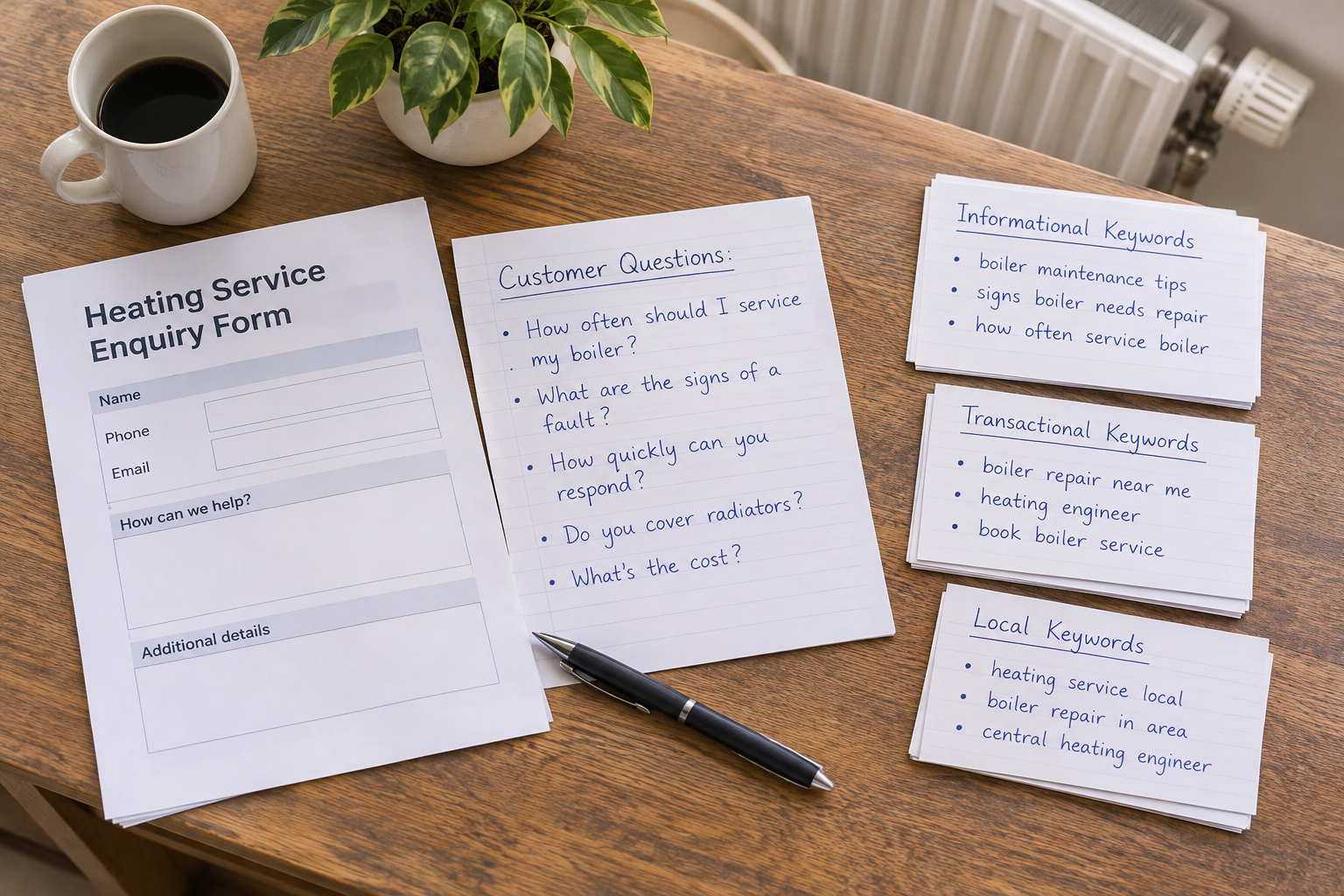
For the hypothetical heating business, early topic groups might include routine servicing, signs of a heating problem and choosing an installer. These are starting points rather than claims about search volume. Check the language and demand in your chosen research tools before committing resources.
- Service intent: The searcher may be looking for someone to carry out a job. A clear service page is often a better fit than a general blog post.
- Informational intent: The searcher wants to understand an issue or decision. A helpful guide can answer the question and link naturally to a relevant service page.
- Local intent: The searcher wants a provider in a particular area. Include accurate service-area information where it helps visitors, rather than creating near-identical pages for every place name.
- Comparison intent: The searcher is weighing options. Explain relevant differences and limitations without pretending that one answer suits everyone.
Review the actual search results for promising phrases. Notice the types of pages appearing and the questions they address. Results can suggest intent, but they are not a template to copy: your page should reflect your own services and expertise. If a topic involves safety or regulated work, have a qualified person review the content and avoid presenting generic advice as a substitute for an inspection.
Next, group closely related phrases under one main topic. Assign that topic to an existing page where possible, rather than creating several pages that answer the same question in almost the same way. Record the intended reader, the action they may want to take and any information the business needs to verify. For a broader process, use this keyword research strategy checklist.
Audit the Website: What Could Stop Good Content Working?
An audit connects your research to the site you already have. Start with a page inventory: list important service pages, articles and contact routes, then note their purpose, relevance and condition. You do not need an exhaustive technical report before making any improvements, but you do need to recognise issues that prevent key pages from being found or used.

Check whether important pages are accessible, whether navigation makes sense and whether internal links lead visitors to useful next steps. Review page titles and headings for clarity. Look for outdated service details, duplicate or overlapping content, broken links and pages that make it difficult to contact the business. On mobile, try the actual journey from a search result to an enquiry.
Use Google Search Console, where available, to inspect search performance and indexing information for the verified site. Treat a report as a starting point for investigation, not proof that every flagged item has the same business impact. Google's SEO starter guide is a useful reference when assessing discoverability and page structure.
In the scenario, the owner might find that a maintenance page already exists but does not explain what the service covers or how to request it. Improving that page could be more useful than publishing a new article on the same subject. If a technical issue affects many important pages, involve whoever manages the site before adding more content.
Prioritise findings by customer impact, the importance of the affected page and the effort needed to fix the issue. Keep a record of the problem, evidence, owner and next action. Avoid treating every automated warning as an emergency: first establish whether it affects your actual site and whether the proposed change is appropriate.
Turn Findings Into a Content Plan
Bring the keyword groups and audit together in a simple page map. For each priority topic, decide whether to improve an existing page, create a new one or leave it for later. Give every planned page a specific purpose: a service page should help someone assess and request the service; an article should answer a genuine question without hiding the answer behind a sales pitch.
A useful brief includes the intended audience, the question to answer, the relevant service or product, authoritative information to check and an appropriate next step. Add an owner and review date. For specialist topics, identify who can check accuracy before publication. Internal links should help readers move between related resources, not force the same anchor text onto every page.

For the hypothetical business, the first piece of work could be an improved maintenance page, followed by an article answering a common servicing question. The article could link to the service page where relevant. The business should only promise services it actually provides and should review local and technical details before publishing.
Epicurus One can help turn approved topics into a publishing workflow: it finds keywords, writes on-brand articles and offers a drag-and-drop content calendar. It connects directly to WordPress, Shopify and Wix, and can publish via Make or Zapier. You can scan a site free in about 10 seconds and start a 3-day free trial that delivers daily articles. Review drafts for accuracy and fit before deciding what to publish.
For the operational side, see the automated content creation and posting playbook. Automation can reduce routine work, but it does not replace business knowledge, editorial judgement or a review process.
How Should Link Building Support the Strategy?
Link building works best when it starts with something genuinely useful to another site's audience. In the scenario, that might be a clear resource about preparing for a heating service, provided the business can make it accurate and useful. The owner could look for relevant local organisations, community resources or industry publications where that subject fits.
Before making contact, check the prospect's audience and the context in which a reference would help. A short, personal message can explain the resource and why it may be relevant. Do not assume that every prospect will link, and do not make an exchange or payment that violates search engine policies. A useful relationship can be worthwhile even when it does not produce a link.

Keep outreach records simple: prospect, relevant page, reason for contact, date and response. Review any acquired links for relevance and accuracy. Avoid buying links intended to manipulate rankings, using automated link schemes or placing misleading content solely to obtain links. Google's search spam policies explain practices to avoid.
Not every page needs a separate outreach campaign. A genuinely useful resource may support several related pages through sensible internal linking. Equally, a service page with clear business information and a good customer journey can be valuable even if it is not the obvious target for external links.
Which Signals Should You Review?
Set a baseline before making changes so you can compare later periods. Choose measures that relate to the objective, not just the amount of content published. For an enquiry-led business, that might mean looking at organic search visibility for relevant pages alongside enquiries from those pages, where tracking and privacy arrangements permit.
- Discoverability: Can important pages be found and indexed? Investigate unexpected exclusions or changes rather than assuming the cause.
- Search relevance: Which queries and pages appear in Search Console, and do they align with the services and questions you prioritised?
- Visitor action: Can people find contact details, request a quote or take another useful next step?
- Content quality: Are facts current, links working and pages still aligned with what the business offers?
- Outreach quality: Are you contacting relevant sites with a useful reason, rather than chasing a raw link count?
Review changes regularly, but allow for the fact that search performance can vary for many reasons. A page update, seasonal demand, competition or measurement changes may all affect what you see. Avoid attributing a result to one action without sufficient evidence. Use the review to decide whether to refine a page, investigate a technical issue or adjust priorities.
Watch: Explore the Connected SEO Workflow
For a visual introduction, search for a walkthrough that explains how keyword research, technical checks and ethical link building inform one another. Compare any advice with your site's actual needs and current search engine guidance.
Frequently Asked Questions
Should keyword research come before a website audit?
Start with enough research to understand the business's priorities, then audit the pages that matter most. The two activities inform each other: existing search data can suggest topics, while research can reveal gaps in the current site. If an obvious technical problem blocks important pages, address it rather than waiting for a complete research project.
Can a small business handle its own link building?
Yes, if it has time to create useful resources and contact relevant organisations thoughtfully. Start with genuine relationships and opportunities that make sense for the audience. Keep records and avoid schemes designed to manipulate rankings. If an agency helps, ask how it selects prospects and what outreach it performs on your behalf.
Does every keyword need a new article?
No. Related searches can often be answered on one useful page, and an existing service page may be the right place for a commercially focused topic. Check the search intent and your current content before creating anything new. Separate pages are more appropriate when the audiences or questions are meaningfully different.
Can automated articles replace an SEO audit?
No. Content creation can help address genuine topic gaps, but it cannot by itself identify or resolve every indexing, navigation or usability issue. Audit the site, set priorities and review generated drafts for accuracy, relevance and brand fit. Publishing more pages is not a substitute for making important existing pages useful and accessible.
How should agencies manage several clients' strategies?
Use a shared process for inventories, briefs, reviews and reporting, while keeping each client's goals and audience distinct. Agree who approves content and technical changes. Epicurus One supports multiple sites from one account and includes team access controls; teams should still establish their own responsibilities and editorial checks.
Ready to put a content plan into practice? Explore keyword research for small businesses, then use the free site scan and trial at Epicurus One to assess whether the workflow fits your team.