Keyword Research Strategy for Real Estate: A Practical FAQ-Led Explainer
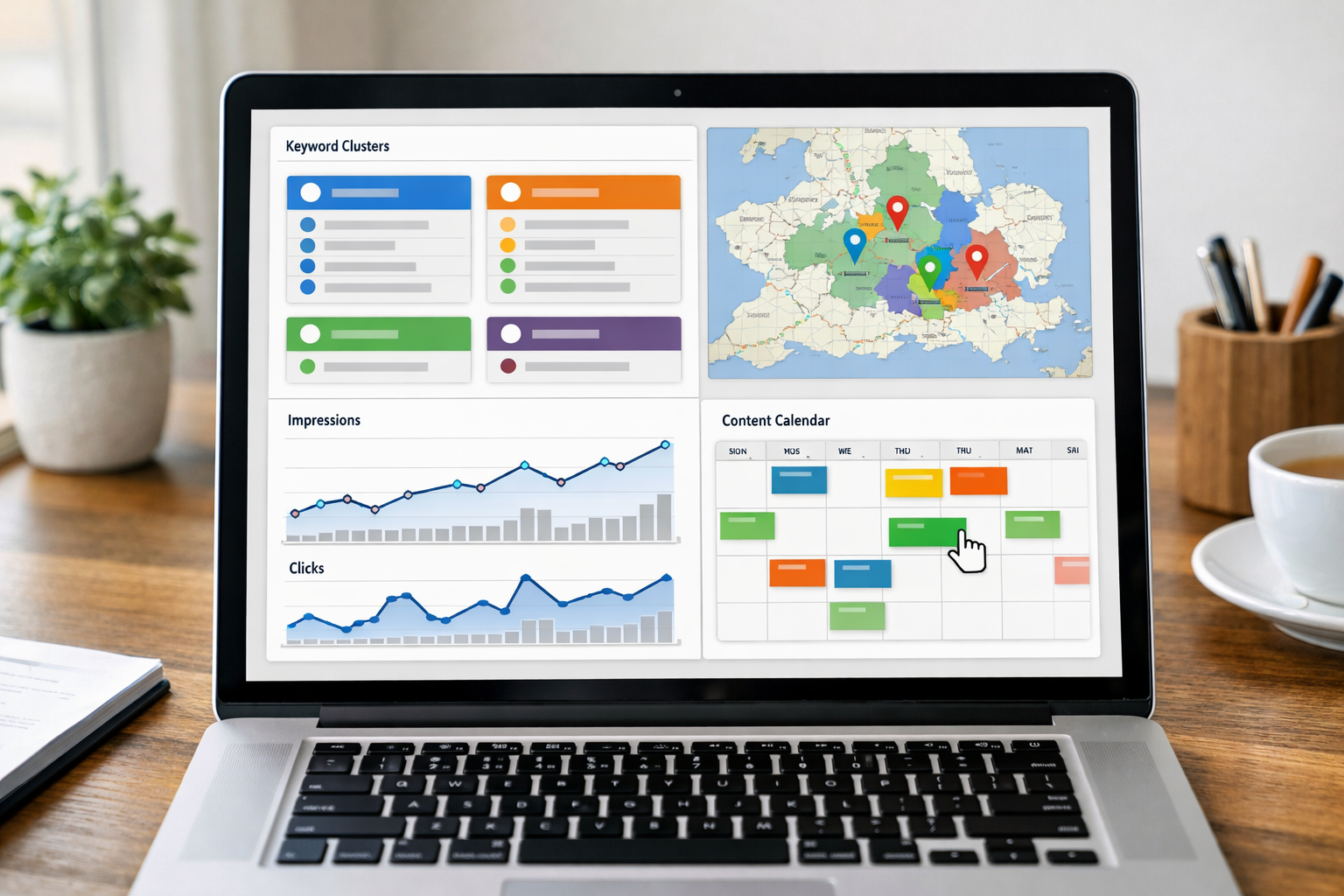
The best keyword research strategy for real estate blends local intent, property lifecycle terms and service-led queries into a simple, repeatable workflow. Start by mapping locations and property types, validate with volume and SERP intent, then group terms to pages and blogs. Prioritise lead-ready phrases, ship content weekly and review performance monthly.
What Does Good Keyword Research Look Like for Property Businesses?
Great research in property is less about building a giant spreadsheet and more about understanding searcher context. Buyers, sellers, landlords and tenants all search differently, and their intent shifts by stage. The strongest plans mirror these journeys while respecting how location, property type and urgency shape the query. That’s why the groundwork starts with audience and territory mapping, not tools.
For example, a first-time buyer tends to search educational content ("shared ownership pros and cons"), then graduates to location + property type ("2-bed flats near Manchester Piccadilly"). A landlord might prioritise outcome terms ("best lettings agent fees in Bristol") and compliance moments ("EPC rules for HMOs"). A seller focuses on value and certainty ("how to sell my house fast in Leeds"). Your structure should reflect these distinct tracks.
Once you understand who searches and why, you can translate that into a clean keyword framework:
- Core commercial pages: location + service queries ("estate agent in [area]"), valuation pages and property type hubs.
- Evergreen education: financing, conveyancing, timelines, landlord compliance and market terminology.
- Hyperlocal discovery: neighbourhood guides, school catchments, transport links and price-trend explainers.
- Timely updates: regulatory change notes, quarterly market snapshots and seasonal checklists.
Finally, robust research aligns targets to real pages. Each primary term gets an owning URL to avoid cannibalisation, and supportive topics feed that page via internal links. This gives you topical coverage, a clearer crawl path and a better shot at rankings that translate to enquiries.

The Tools and Data You Actually Need (and What to Skip)
Tools should speed decisions, not replace judgment. You need coverage of four jobs: discovering terms, validating intent, gauging difficulty and tracking outcomes. Everything else is optional. A compact stack is easier to maintain and keeps teams focused on shipping content, not refining spreadsheets that never get published.
Here’s a pragmatic view of what helps and what often distracts:
| Job | Recommended sources | When to use | What to skip |
|---|---|---|---|
| Discover ideas | Keyword tools, Google autosuggest/People Also Ask, internal site search logs | Kick-off research and quarterly refreshes | Endless scraping of low-relevance long-tails |
| Validate intent | Manual SERP review, competitor page analysis | Before committing a term to a page | Blindly trusting category labels in tools |
| Difficulty assessment | Domain/page authority proxies, SERP feature check | Prioritising quick wins versus long plays | Chasing only high-volume, head terms |
| Performance tracking | Search Console performance reporting, analytics goal tracking | Monthly/quarterly review cycles | Daily ranking micro-swings without context |
Remember that data quality varies by geography. Smaller towns or niche property types may show sparse volume estimates even when demand is real. Treat volumes as directional. Cross-check with your CRM enquiry sources, on-site search, and regional signals like new-build activity or landlord forums to decide if a theme merits coverage.
Building Your keyword research strategy for real estate, Step by Step
A reliable system turns research into results. The following cadence keeps teams shipping while maintaining quality:
- Map your service footprint. List every sale/let area you serve down to neighbourhoods. Include property types (flats, terraces, HMOs, student lets) and service lines (sales, lettings, management, valuations).
- Draft seed topics by audience. Buyers, sellers, landlords, tenants. For each, sketch lifecycle questions (discovery, evaluation, action) and compile 10–20 seeds per audience.
- Expand and cluster. Use keyword tools and SERP suggestions to expand. Group by intent (informational vs transactional), then by location and property type. Keep clusters tight enough to serve with one page.
- Validate SERP intent. Open the results for your target term. If top results are guides, plan a guide; if they are agency pages, build a service page. Don’t fight the dominant intent.
- Assign a single owning URL. Avoid cannibalisation by giving each primary term one page owner. Support with related posts that link up, not sideways competition.
- Prioritise by potential + difficulty. Mix quick wins (longer-tail locations) with strategic bets (city hubs). Score each cluster by commercial value, local demand and SERP strength.
- Plan the calendar. Set a weekly or fortnightly cadence and slot in a balance of service pages, local guides and education. Protect strategy slots for high-value pages.
- Publish, interlink and measure. Launch with clear internal links from related pages and add conversion points (valuation CTAs, enquiry forms). Review rankings and leads monthly to refine.
This process scales from a solo agent to a national franchise, provided you cap scope and work in sprints. Keep a backlog, timebox research, and always move a handful of clusters into production every cycle.
How Do Local vs National Intent Affect Property Keywords?
Property searches are overwhelmingly local. Even generic phrases take on local flavour once a user adds a place, school or transport landmark. National queries tend to be educational (mortgage concepts, selling timelines, landlord compliance), while action-oriented searches—"estate agent in [area]", "3-bed house to rent in [postcode]"—skew hyperlocal and change rapidly with stock and seasonality.
When building content, split your plan into national education that earns links and trust, and local pages that convert. Neighbourhood guides, catchment overviews and commute-time breakdowns are powerful for discovery. To size local opportunities realistically, triangulate tool volumes with real-world context such as ONS population estimates and local development pipelines. A village of 3,000 won’t show big volumes, but local dominance could still be profitable.
Use this lens to steer your mix: national guides for authority, local pages for leads. Over time, you can link from national guides to local pages to pass relevance. If your plan explicitly separates these, your keyword research strategy for real estate stays tidy and your site architecture becomes intuitive for users and crawlers alike.

Can You Balance Lead Quality with Search Volume?
Yes—by weighting decisions toward intent and conversion friction, not volume. High-volume head terms like "estate agents London" are fiercely competitive and broad. A mid-volume, precise query such as "sell flat quickly in Hackney" or "landlord HMO management in Reading" often yields better lead quality because the user has already filtered themselves by problem and place.
Evaluate terms on three axes: user readiness (how close to action), local specificity (place + property type) and your differentiator (speed, fees, niche expertise). A query aligned with all three will usually convert well even with modest volume. Add strong on-page conversion—valuation widgets, fee calculators, WhatsApp chat—and you amplify returns from each ranking.
Blend intent levels in your calendar. Anchor it with commercial pages (valuation and service hubs), support them with neighbourhood and property-type content, and use educational guides to win trust and links. Over a quarter, this balanced set tends to win both enquiries and authority growth.
Want to scale this without managing writers? Start your free 3‑day trial of Epicurus One to scan your site, auto-build a calendar and publish on-brand articles directly to WordPress, Shopify or Wix—no copy‑and‑paste.
Mapping Keywords to Pages and Content Types
Turning research into a site that ranks relies on smart mapping. Assign each cluster to a single, clear page type. Resist the urge to create multiple near-duplicates; instead, build one stronger hub and support it with related posts that link up. This improves crawl efficiency, reduces cannibalisation and clarifies user journeys.
Use this simple mapping guide when planning sprints:
| Intent | Example query | Best page type | Supporting content | Primary conversion |
|---|---|---|---|---|
| Transactional (local) | estate agent in Stockport | Location service page | Neighbourhood guide, fees explainer | Valuation booking |
| Commercial research | letting agent fees Bristol | Service hub page | Fee calculator, landlord checklist | Enquiry form |
| Informational (national) | how long does conveyancing take | Comprehensive guide | Process timeline, solicitor Q&A | Newsletter / valuation soft CTA |
| Local discovery | best schools in Walthamstow | Neighbourhood guide | Transport, parks, price trends | Property alerts signup |
As you scale, create a living map: each primary term, its owning URL, and internal links that support it. Review monthly and reassign where clashes emerge. Keeping this discipline will make your keyword research strategy for real estate resilient as new topics and areas are added.

Competitor Gaps: Finding the Openings They Miss
Competitors often over-optimise for head terms and neglect long-tail intent or micro-areas. That’s your opening. Review their navigation and sitemaps: do they have distinct pages for each neighbourhood, or have they bundled everything into a single city page? Are there thin service pages without unique value propositions, fee transparency or local proof points?
Scan local data to spot opportunities competitors ignore. For sellers, align content with demonstrable trends—link to authoritative sources such as HM Land Registry price paid data when discussing typical sale timelines or ranges by area. For buyers and tenants, build guides around transport improvements, planned developments and school changes that rarely surface in basic keyword lists.
Then, benchmark SERPs: where competitors rank with weak pages, mark them as quick wins. Where they win with strong evergreen guides, plan a differentiated angle (depth, interactivity, calculators, local maps) rather than me-too rewrites. Finally, strengthen internal linking to concentrate authority on the pages that can realistically leapfrog the current results.
Workflows That Keep Content Shipping Without Managing Writers
Consistency beats intensity. The most successful teams lock into a weekly or fortnightly cadence and protect publishing time. Start with a three-column workflow: backlog, in progress, published. Each card contains the target query, owning URL, H1, outline, internal links and conversion element. This way, anyone can pick up a card and move it to done.
Automating repetitive steps helps small teams punch above their weight. Use templates for neighbourhood guides, service pages and FAQs so your voice stays on-brand and the essentials—local proof, CTAs, internal links—never get missed. For a hands-off process, see the automated content creation and posting playbook and this content optimisation tools FAQ for practical shortcuts.
Agencies running multiple sites should add access controls, a drag-and-drop calendar and direct publishing to WordPress, Shopify or Wix. That removes copy‑and‑paste friction and makes approvals faster. If you prefer a detailed planning approach first, our advanced keyword research walkthrough shows a step-by-step scenario you can mirror.

Metrics That Prove It’s Working in 2026
Focus on a small, trustworthy set of metrics. For discovery, track impressions and average position in Search Console at the cluster level. For engagement and intent, watch click-through rate on key pages and on-site behaviours such as valuation tool starts. For revenue signals, attribute enquiries and completed valuations to landing pages and clusters.
Create a quarterly dashboard showing trend lines for each core area you serve. Correlate movement with your publishing cadence and internal linking updates. When a cluster gains impressions but not clicks, improve titles and meta descriptions; when it gains clicks but not enquiries, strengthen CTAs and proof points. This is how a keyword research strategy for real estate evolves from theory to pipeline.
To stay honest with the numbers, rely on transparent sources like the Search Console performance report and your CRM. By 2026, teams that keep this feedback loop tight will outpace those chasing daily rank swings without tying them to leads and completions.
Common Mistakes (and How to Fix Them Fast)
Several pitfalls derail otherwise solid plans. The first is over-reliance on generic head terms, which burns time without shifting leads. Fix it by rebalancing toward specific, local and lifecycle queries you can actually win. The second is mixing multiple clusters into one page—SERPs dislike fuzzy intent. Split pages cleanly and interlink them.
Another trap is forgetting conversion. A beautifully researched neighbourhood guide that hides the valuation CTA will underperform. Add obvious, helpful next steps: valuation widgets, fee calculators, property alerts. Finally, teams stall when each page becomes an epic. Publish smaller, better-scoped pieces consistently, and layer depth over time with updates and internal links.
When deadlines slip, reduce scope, not standards. Keep templates tight, batch outlines, and protect a non-negotiable publishing slot in your calendar. Momentum compounds—content that ships reliably is easier to improve than drafts stuck in approval limbo.

Frequently Asked Questions
How many keywords should each page target?
One primary term per page, with a handful of closely related variations that match the same intent. If the SERP shows mixed intent, split the topic. Use internal links to connect supporting pages back to the primary page to consolidate relevance and authority without creating overlap.
Do I need a separate page for every neighbourhood?
Only if you can add unique value: local amenities, schools, transport, prices, photos and testimonials. If you can’t differentiate, start with broader area pages and expand to micro-areas over time. Quality and usefulness beat thin duplication across dozens of near-identical pages.
What’s the right publishing cadence for a small team?
Weekly or fortnightly works for most. Commit to one substantial page (service or guide) plus one supporting piece (FAQ or update) per cycle. Protect that slot, keep templates ready, and measure impact monthly so you know whether to increase cadence or double down on internal links and CTAs.
How long before local pages start ranking?
Typically a few weeks to a few months, depending on competition, domain strength and internal linking. Speed it up by ensuring strong on-page signals (clear titles, H1s, headings), local proof (maps, testimonials), and links from relevant internal pages. Keep updating with fresh details and recent market notes.
Should I chase featured snippets and People Also Ask?
Yes, when they align with your target intent. Add concise Q&A sections, definitions and step lists within relevant pages. However, don’t rebuild content solely to win a snippet if it weakens conversion. Balance clarity for search with strong, visible next steps for users ready to enquire.
Ready to grow organic traffic without managing writers? Start your plan today, keep the workflow simple, and let automation handle the heavy lifting. When you’re set, start your free trial and publish on schedule—your future pipeline will thank you.